
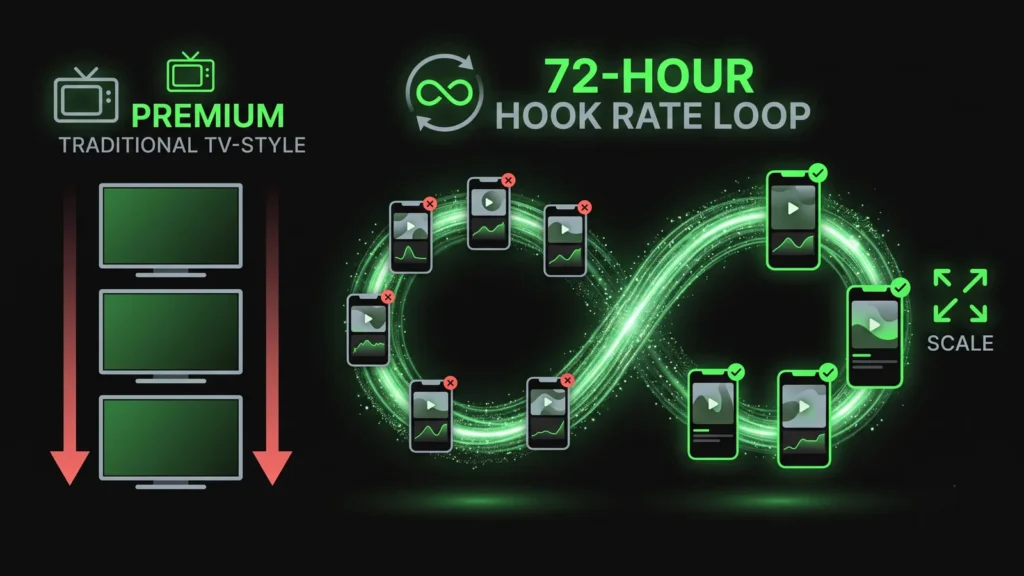
The creative brief for most paid social campaigns still asks for “premium” production — a handful of polished 15 to 30-second spots, each given a two-week window to prove itself before anyone reviews the results. That structure was built for television, where a small number of expensive assets running for a long window made sense. It doesn’t survive contact with a feed.
Why the two-week cycle is already dead by the time it starts
We took over an account running exactly that model: five polished spots, each tested for fourteen days before a human review decided which to keep. By the time that review happened, two things had already occurred without anyone deciding them. The feed’s cultural context had moved on from whatever made the concept relevant when it was shot. And the platform’s delivery algorithm had already formed its own opinion, usually within 48 to 72 hours, quietly throttling delivery on the underperformers — meaning the “two-week test” was actually an eleven-day period of the algorithm confirming a decision it made in the first three days, while the human review process lagged behind it the entire time.
The loop we run instead
Eight rough variants, launched simultaneously, evaluated on hook rate — the percentage of viewers still watching past the first three seconds — at the 72-hour mark, not two weeks. Anything below the account’s hook rate baseline gets killed. Anything above it gets a budget increase and stays in rotation. New variants get added continuously rather than in batches, so the loop never fully resets — there’s always something in a 72-hour evaluation window, and always something that just graduated out of one.
“Rough” doesn’t mean careless. It means shot to look native to the platform it runs on — handheld, vertical, unpolished lighting, often literally filmed on a phone — rather than a downsized television spot with a logo bumper. The production standard that reads as quality on a TV screen reads as an ad the moment it appears in a feed built on everything else looking unpolished and personal.
Where the budget actually goes
Roughly 20% of monthly media budget stays reserved for testing new variants at any given time, distributed across the eight-slot rotation rather than concentrated in one “hero” asset. The remaining 80% scales behind whatever’s currently winning. That ratio shifts as an account matures — newer accounts need a larger testing pool to find a working creative direction at all, established accounts can run closer to 90/10 once a durable creative pattern is found.
What changed in the account
Production cost dropped by more than half, since eight rough variants cost less to produce than five polished ones. Time to identify a winning concept dropped from roughly a month to under two weeks. And the single best-performing ad in the account’s history, six months in, was a video a real customer had posted organically — the team found it, licensed it, and ran it as-is. It outperformed every agency-produced asset in the account by a wide margin, which is either a humbling data point or the entire argument for this approach, depending on how you look at it.