
In March, a client’s product marketing lead sent us a screenshot with one line: “Is this us?” It was a ChatGPT answer to “what’s the best project management tool for a 10-person agency,” and buried in the fourth sentence, unlinked, was their product name. Not a link. Not a click. Just a mention, sourced from a page they’d published eighteen months earlier and mostly forgotten about.
That screenshot is the reason this post exists. The team had spent two years doing everything a good SEO checklist tells you to do — clean titles, internal linking, decent word counts, real backlinks. Rankings for their category terms were solid, top five for most of them. And none of that explained why they were being casually cited by an AI system for a query they didn’t even rank on page one for. Something else was going on, and once we went looking, it wasn’t subtle.
The reader changed, and most content didn’t
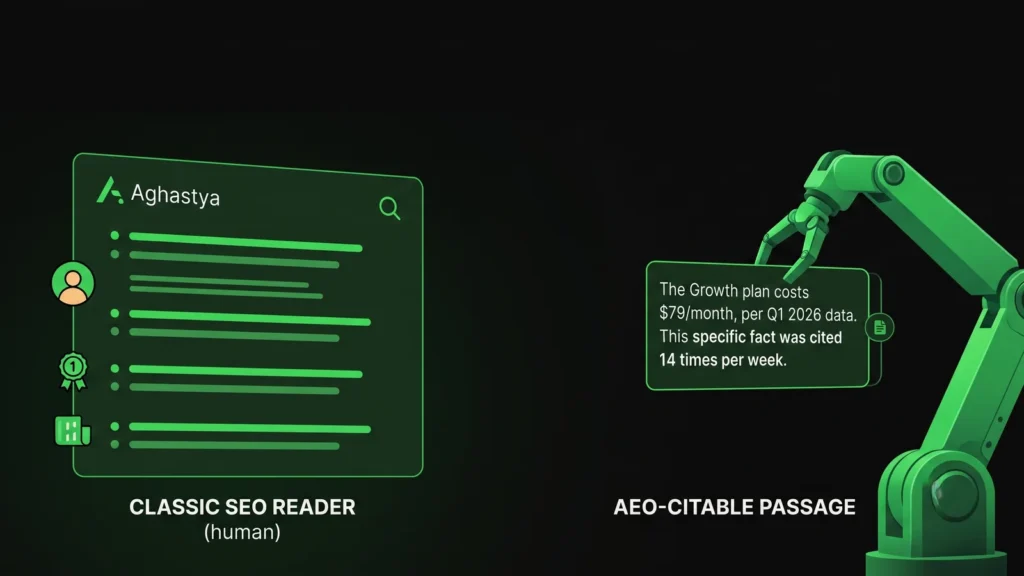
Classic SEO was written for a specific reader: a human, scanning a results page, deciding in about two seconds whether to click. Everything about the format — the friendly intro, the “in this article we’ll cover,” the slow build toward the actual answer — exists to keep that human on the page long enough for the click to count and the dwell time to look good in analytics.
An answer engine is not that reader. It isn’t deciding whether to click. It’s deciding whether to lift a passage — pull a self-contained chunk of text out of your page and place it, sometimes with attribution and sometimes without, directly into its response. That’s a completely different job, and it rewards a completely different shape of writing.
Here’s the practical difference. A human reader will forgive three paragraphs of throat-clearing before you get to the point, especially if the throat-clearing is well written. A retrieval system evaluating your page against forty other candidates for the same question will not. It’s not reading for style. It’s scanning for the shortest, cleanest, most self-contained unit of text that answers the question completely on its own, without needing anything above or below it for context.
What a citable passage actually looks like
We call it the “orphan test.” Take any paragraph on the page, delete everything else around it, and ask: does this paragraph still make complete sense? Does it still contain the claim, the specific number, and enough context to stand alone? If the answer is no — if it depends on “as mentioned above” or “building on this” — it will not get cited, no matter how accurate or well-researched it is.
Here’s the same paragraph from that client’s pricing FAQ, before and after we rewrote it with the orphan test in mind.
Before: “Choosing the right plan can feel overwhelming with so many options available today. At [Client], we believe pricing should be simple and transparent, which is why we’ve worked hard to design a structure that fits businesses of every size. Our most popular plan, which many customers choose, offers a great balance of features and value for growing teams.”
After: “The Growth plan costs $79/month and includes unlimited projects, 10 team seats and priority support. It’s the plan 68% of new customers chose in Q1 2026, according to our own signup data.”
Same underlying fact. The first version buries it under four sentences of preamble that exist purely to sound warm and human. The second version states the claim, the number, and the source in one sentence that would survive being lifted out of the page entirely. That’s the only version an answer engine has any real use for.
A framework for restructuring existing content
We don’t rewrite whole sites from scratch — most of the time that’s neither necessary nor affordable, and it isn’t where the return is. Instead we run every high-intent page through the same five-step pass:
- Find the buried answer. Read the page as if you’re in a hurry. Where does the actual claim first appear? If it’s past the second paragraph, that’s the first thing to fix.
- Move it to the top, and make it survive alone. Rewrite the opening so the first two sentences under any heading state the claim and the number directly — no scene-setting first.
- Attach a source and a date to every number. “Most customers prefer X” gets ignored. “68% of customers, per our Q1 2026 data” gets cited. Specificity is what makes a claim quotable instead of generic.
- Add structure the retrieval system can parse. Proper heading hierarchy, FAQ schema where it’s honestly applicable, tables for anything comparative. This isn’t a trick — it’s making the structure match what’s already true about the content.
- Cut anything that only exists to sound human. “In today’s fast-paced digital landscape” has never once helped a reader or a retrieval system. It’s dead weight either way.
What we track instead of rankings
Rank tracking still matters, but it’s no longer the whole picture, and treating it as the whole picture is how teams miss exactly the kind of win that started this post. We now track citation share alongside rankings — how often a client’s brand or product gets surfaced in AI-generated answers for their category’s core questions, sampled weekly across the assistants their audience actually uses.
For that client, citation share went from roughly two mentions a week to fourteen over ten weeks, without a single new backlink and without a ranking change worth mentioning. Organic traffic from classic search barely moved. Direct traffic and branded search did — because people were hearing about the product from an AI answer, then searching for it by name to check it out. That’s a conversion path that doesn’t show up in a rankings report at all.
The mistake we see most often
Teams treat AEO as an add-on task — a checklist item bolted onto the existing SEO process, usually assigned to whoever has the least on their plate that quarter. It isn’t an add-on. It’s a rewrite of the same instinct that made SEO work in the first place: understand exactly what the system reading your page actually wants, and give it that, without making the reader do the work of finding it.
The checklist changes. The instinct doesn’t. Most teams still have the instinct — they’re just aiming it at a results page that increasingly doesn’t exist.